In modern manufacturing, industrial compressed air serves as a critical utility across production lines. Among the various technologies available, rotary screw air compressors stand out as the workhorses of heavy industry. They offer a continuous, reliable flow of air required to power pneumatic machinery, automated systems, and critical plant workflows.
However, operating these robust systems effectively demands a solid understanding of how they work, how to maintain them, and how to optimize their energy consumption.
To help mechanical engineers, plant managers, and facility operators maximize system uptime, Loitha Air Compressor—a global leader in energy-efficient air systems with over a decade of certified manufacturing experience—has compiled and answered the top ten most frequently asked questions about industrial screw air compressors.
Industrial Screw Air Compressors: Comprehensive FAQs & Technical Answers
1. Why Is My Screw Air Compressor Producing Less Air Than Expected?
A sudden or progressive drop in volumetric airflow (measured in Cubic Feet per Minute, or CFM) can stall downstream automation and impact total factory throughput.
Common Causes:
- Clogged Air Intake Filter: Restricts incoming ambient air, creating an artificial vacuum and reducing the mass of compressed air inside the system.
- Dirty Oil Separator Element: Increases internal backpressure, preventing the fully compressed air from discharging smoothly into your system lines.
- Air Leaks in the Piping Network: Wastes pressure out into the atmosphere before it ever reaches production tools.
- Worn Air-End Components: Worn internal clearances or rotor profile degradation within the rotary block allow air to slip backward during the compression cycle.
- Incorrect Pressure Settings or Blocked In-Line Treatment: Blockages in downstream particulate filters or automated dryers choke the air stream.
The Professional Solution:
Implement a predictive maintenance protocol. Consistently clean or replace intake media, perform automated ultrasonic leak testing along your header pipes, and monitor air-end vibrations to catch rotor wear early.
2. What Is the Ideal Operating Temperature for a Screw Air Compressor?
Industrial screw compressors rely on lubricant injection to seal the tight spaces between spinning rotors, cool the compressed air stream, and protect moving parts. If operating temperatures drift outside safe ranges, the lubricating oil can degrade rapidly.
Recommended Temperature Thresholds:
- Normal Operating Range: 75°C to 95°C (167°F to 203°F)
- High-Temperature Warning Level: Above 100°C (212°F)
- Automatic Safety Shutdown Level: Typically triggers at 105°C (221°F)
Key Factors Leading to Overheating:
- Fouled or clogged liquid/air heat exchangers (coolers).
- Insufficient or degraded oil levels within the sump tank.
- Poor ambient ventilation or high engine room ambient temperatures exceeding 45°C.
- Blocked oil filters slowing down fluid circulation.
Technical Note: Running a compressor at consistently high temperatures accelerates oil oxidation, thin out film thickness, and can lead to a sudden thermal shutdown, halting production completely.
3. How Much Electricity Does a Screw Air Compressor Consume?
Compressed air accounts for a major share of total electricity costs in industrial plants. The exact energy usage of your equipment depends on your motor’s nominal power rating, overall runtime, and your system’s fluctuating air demand.
Approximate Power Consumption Guide:
| Compressor Size (HP) | Nominal Power Rating (kW) | Typical Operational Profile |
| 10 HP | 7.5 kW | Light assembly, small machining shops |
| 15 HP | 11 kW | Auto body, localized production lines |
| 20 HP | 15 kW | Mid-sized manufacturing, continuous stamping |
| 30 HP | 22 kW | Industrial packaging, textile operations |
| 50 HP | 37 kW | Heavy fabrication, ceramic plants, casting |
Actionable Ways to Lower Energy Costs:
- Transition to VFD Systems: Swap out legacy machines for variable frequency drives that scale motor speeds to match real-time air demand.
- Aggressive Leak Mitigation: Fixing common pipe joint leaks can cut total baseline energy draw by up to 20%.
- Optimize System Pressure: Avoid over-pressurizing your loop. Lowering the system pressure setting by just 1 bar reduces total motor power draw by roughly 6% to 8%.
4. What Is an Air-Oil Separator and How Does It Function?
An air-oil separator is a multi-layered filtration cartridge positioned within the primary discharge vessel of an oil-injected rotary screw compressor.
Primary Mechanics & Benefits:
As the high-velocity mixture of compressed air and atomized lubricant leaves the air-end, it enters the separator tank. Mechanical redirection drops out the bulk fluid, while the fine separator element forces tiny oil droplets to coalesce and drain out.
- Purity: Delivers clean, low-carryover compressed air downstream.
- Fluid Conservation: Collects and recycles expensive compressor lubricants back into the cooling circuit.
- Downstream Component Protection: Prevents sticky hydrocarbon residues from damaging pneumatic valves or contaminating products.
Replacement Window:
For maximum performance, change out your air-oil separator element every 2,000 to 6,000 operational hours, or earlier if your physical instrumentation indicates an internal differential pressure drop exceeding 1 Bar.
5. Why Does an Industrial Screw Air Compressor Require an Air Dryer?
Atmospheric air naturally carries water vapor. When that air is compressed and cooled, the vapor condenses into liquid water inside your infrastructure.
Operational Hazards Caused by Moisture:
- Pitting and chemical corrosion inside downstream steel headers.
- Washout of required factory grease from automated pneumatic cylinders and tools.
- Spoiled or ruined product batches, particularly in electronics, food preparation, and pharmaceutical operations.
Solution Options from Loitha Air Compressor:
Integrating high-efficiency refrigerated air dryers (reducing pressure dew points down to 2°C–8°C) or desiccant air dryers keeps your air lines dry, protects automation systems, and increases overall system reliability.
6. What Working Pressure Should My Compressor Operate At?
There is no single “correct” pressure setting; your target operating pressure must be directly aligned with the highest minimum required pressure among your active production machinery.
Standard Industrial Target Pressures:
- 7 Bar (100 PSI): Standard pneumatic tool systems and basic material handling.
- 8 Bar (116 PSI): Automotive assembly lines and general packaging automation.
- 10 Bar (145 PSI): Precision CNC machining centers, textiles, and heavy forging.
- 13 Bar (190 PSI): Specialized laser-cutting profiles and high-resistance injection molding.
Operational Warning: Avoid over-pressurizing your system. Unnecessarily raising target values forces your machine to consume significantly more power per CFM produced, driving up utility bills without adding production value.
7. Fixed-Speed vs. VFD Screw Air Compressors: What Is the Difference?
[Fixed-Speed Air Demand Matching]
Motor Speed:  ||||||||||||||||||||||||| (100% Constant Speed)
Actual Demand: ▃▅▇▄▃▂ (Fluctuating) -> Wasted Energy via Venting/Unloading

[VFD Variable Speed Matching]
Motor Speed:  ▃▅▇▄▃▂ (Modulates Dynamic RPM)
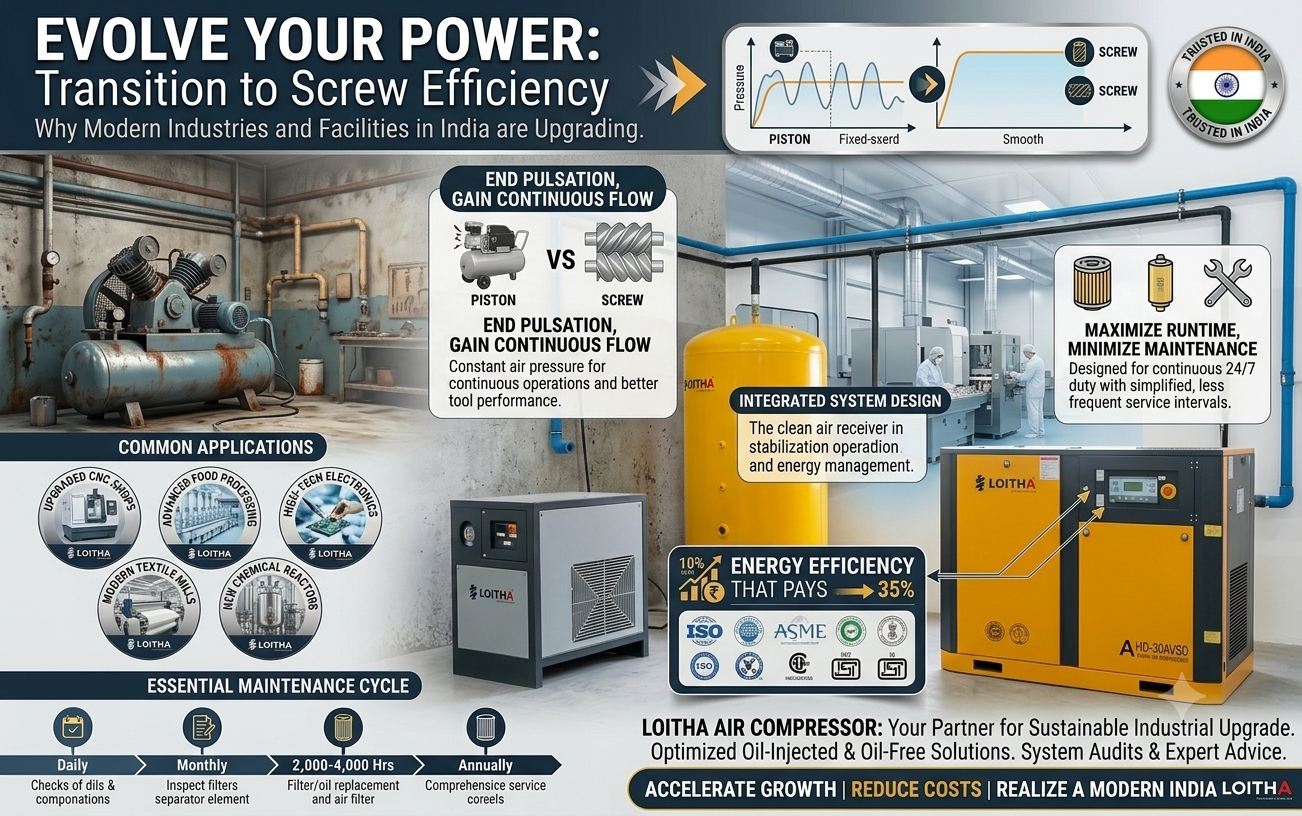
Actual Demand: ▃▅▇▄▃▂ (Fluctuating) -> Saves up to 33-35% Energy Costs
Fixed-Speed Compressors
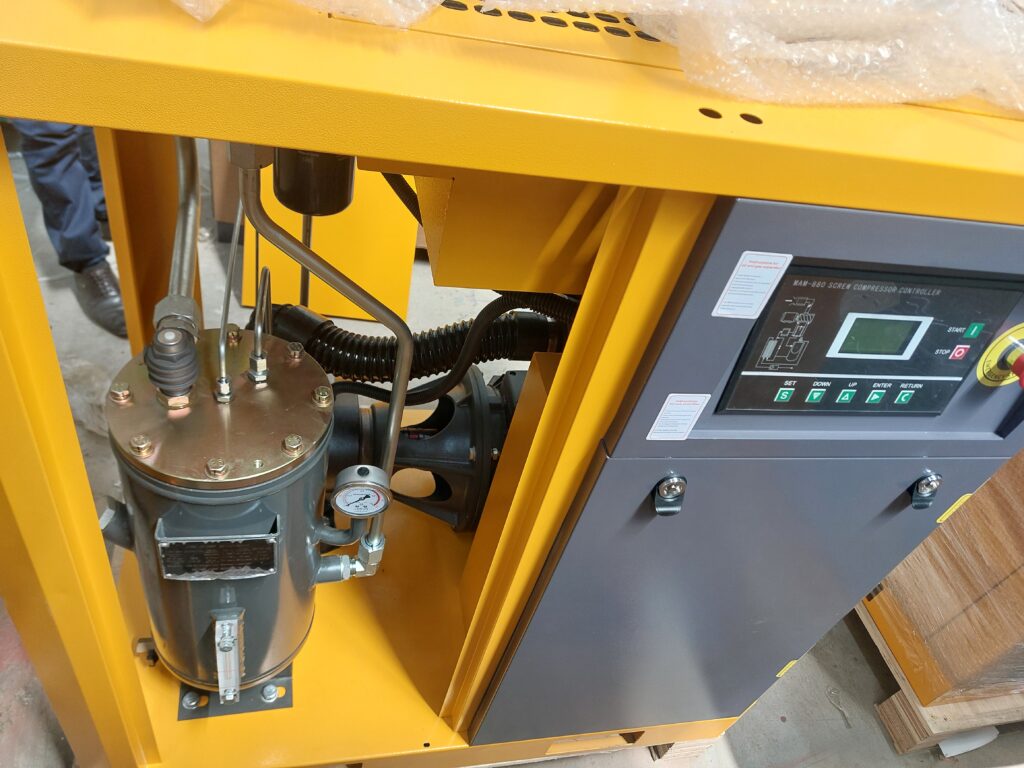
These models run at a single, unchanging motor RPM, relying on an intake valve to load or unload the compressor when pressure targets are hit.
- Advantages: Lower initial equipment purchase costs and straightforward, simple electrical control logic.
- Limitations: High energy waste when air demand drops, as the motor continues to draw considerable power even while running un-loaded.
Variable Frequency Drive (VFD) Compressors
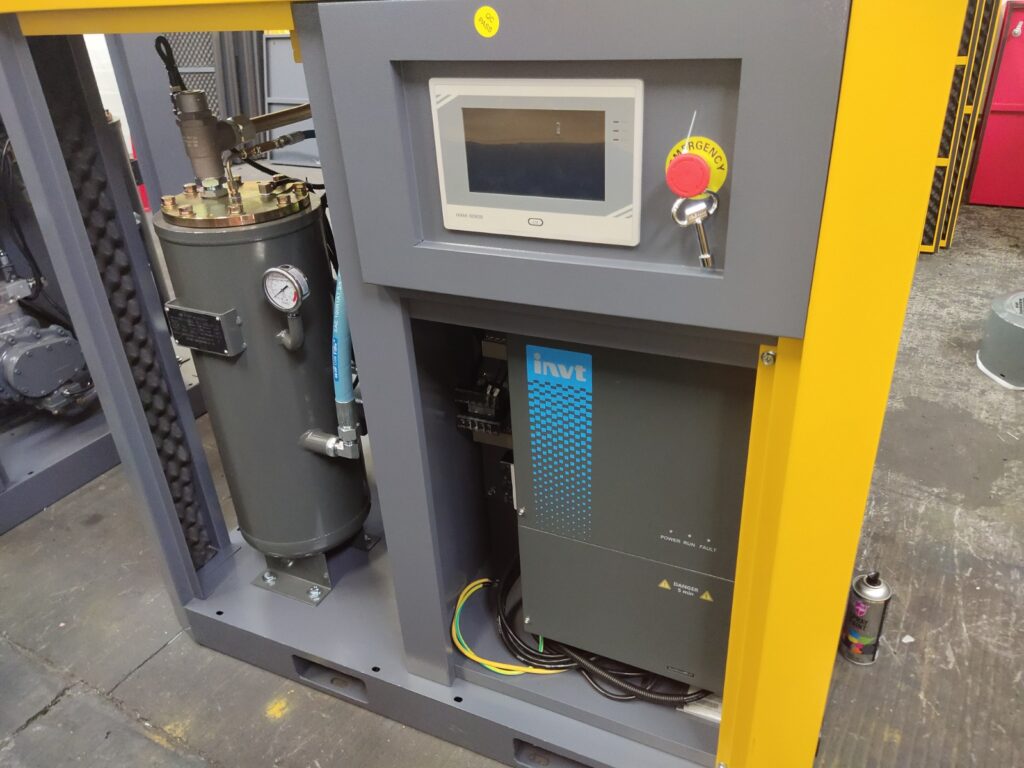
VFD models feature advanced controllers (like Loitha’s Permanent Magnet VSD range) that continuously adjust motor RPM to match real-time production air consumption.
- Advantages: Cuts electrical utility costs by up to 33–35% over fixed-speed setups, provides steady system pressure control, eliminates sudden electrical current spikes during startups, and reduces structural wear.
- Best Application: Ideal for facilities with shifting shift schedules, fluctuating tool use, or variable manufacturing demands.
8. How Can System Air Leaks Impact Total Factory Performance?
Air leaks represent an invisible drain on factory profit margins. In many unmaintained industrial environments, minor piping gaps can waste a substantial portion of a plant’s total compressed air volume.
Common Leak Points:
- Aged or cracked pipe manifolds and threaded joints.
- Degraded manual drain valves or faulty pneumatic pressure regulators.
- Frayed rubber whip hoses and worn quick-disconnect couplers.
The True Business Impact:
Leaks force your air compressors to run longer cycles, which inflates power bills and accelerates your maintenance schedule. This added strain can lower line pressure at critical tools, causing production delays and reducing product quality.
9. How Often Should I Replace Compressor Filter Media?
Replacing filters on time prevents particulate contamination, keeps pressure drops low, and ensures your machinery runs efficiently.
Recommended Industrial Replacement Matrix:
| Filter Core Element | Standard Replacement Schedule | Core Operational Benefit |
| Air Intake Filter | 1,000 to 2,000 Hours | Blocks abrasive ambient dust from scratching precision rotor profiles. |
| Fluid / Oil Filter | 2,000 to 4,000 Hours | Traps carbon particulates to keep oil flowing freely to the bearings. |
| Coalescing Line Filter | 4,000 to 8,000 Hours | Removes fine oil mists and particulates before they reach the main factory line. |
10. What Key Selection Factors Should Be Checked Before Purchasing a Compressor?
Investing in an industrial rotary screw air compressor is a long-term decision that impacts your facility’s operational costs for years to come.
Technical Evaluation Checklist:
- Total Airflow Volume Required (CFM): Sum the consumption ratings of all active pneumatic equipment, adding a 20% buffer for future facility expansion.
- Maximum System Working Pressure (Bar/PSI): Ensure the model safely covers your highest-pressure tool without over-pressurizing the entire loop.
- Plant Load Profile: Determine if your operations feature continuous demand (better for fixed-speed models) or fluctuating demand (perfect for energy-saving VFD models).
- Acoustic footprint: Review noise levels (dB) to ensure compliance with local factory safety guidelines.
- Build Standards & Components: Look for verified quality marks like ISO9001, ISO14001, and CE certifications, along with reliable engineering features like German-profile air-ends and IP54-rated heavy-duty electric motors.
Why Choose Loitha Air Compressor Solutions?
Partnering with an experienced manufacturer makes it easy to keep your compressed air systems reliable and efficient. Loitha Air Compressor delivers high-performance industrial engineering designed for modern manufacturing challenges:
- High-Efficiency Engineering: Our Permanent Magnet (PM) VFD rotary screw compressors help plants reduce energy consumption by up to 35% compared to conventional fixed-speed options.
- Global Quality Standards: Built using advanced German rotor profiles and durable IP54/IE3 high-efficiency motors, all Loitha machinery carries verified ISO9001, ISO14003, and CE certifications.
- Integrated Turnkey Systems: From bare direct-drive or belt-driven screw blocks to tank-mounted configurations complete with high-efficiency refrigerated air dryers and four-stage precision line filtration, we provide complete air solutions.
- Complete Lifecycle Support: Supported by decades of export and manufacturing expertise, our engineers assist you through custom system design, sizing, installation setup, and responsive after-sales service.
Contact a technical specialist at Loitha Air Compressor today to build a reliable, high-efficiency system optimized for your facility’s production goals.
📞 Call: +91 9601415434
📧 Email: info@loitha.com
🌐 Website: www.loitha.com
📱 Follow Us:
Facebook: LothAir/ | Instagram: /loitha_Air/ | YouTube: @LOITHAAir