
Screw Air Compressor Service Tips for Industrial Reliability
A Screw Air Compressor can run for long hours and support critical production equipment, but continuous operation does not mean maintenance can wait until something fails. Filters collect contaminants, lubricant degrades, coolers become dirty, separators can develop excessive pressure drop, and valves or sensors may gradually lose performance.
So, when should you service a Screw Air Compressor?
The practical answer is to combine the manufacturer recommended service interval, actual running hours, controller alerts, operating environment, maintenance history, and machine condition. A compressor working in a clean and controlled room may have different maintenance needs from the same model operating in high heat, humidity, or heavy dust.
This guide explains how to recognize service needs, plan preventive maintenance, and avoid small problems turning into expensive production downtime.
When Does a Screw Air Compressor Actually Need Service
There is no single maintenance interval that applies to every compressor. Oil type, compressor model, operating load, ambient temperature, dust, humidity, filtration, and daily running hours can all influence service requirements.
Therefore, running hours should be treated as an important maintenance trigger rather than the only decision factor.
1. Use Running Hours as Your Maintenance Baseline
Many industrial compressors use controller based service intervals. Depending on the manufacturer and model, maintenance activities may be scheduled at different running hour milestones.
A practical maintenance plan can include:
- Daily checks for lubricant level, leaks, pressure, temperature, alarms, condensate drainage, noise, and vibration
- Periodic inspections of filters, coolers, hoses, electrical connections, belts, couplings, drains, and valves
- Scheduled service based on controller alerts and manufacturer specified running hours
- Condition based service when pressure drop, temperature, lubricant condition, vibration, or performance indicates deterioration
Do not automatically replace every component at a fixed generic interval. Check the service manual for the exact compressor model because lubricant, filter, and separator replacement intervals can differ significantly between machines.
2. Why Operating Conditions Can Shorten Service Intervals
Running hours tell only part of the story.
A Screw Air Compressor installed in a dusty fabrication facility may load its inlet filter faster than one installed in a clean compressor room. High ambient temperatures can also increase thermal stress and accelerate lubricant deterioration.
Service may therefore need to be brought forward when the compressor operates with:
- Heavy airborne dust
- High ambient temperatures
- High humidity
- Restricted ventilation
- Continuous high load
- Frequent start and stop cycles
- Contaminated intake air
- Poor compressor room housekeeping
The goal is not simply to reach the next hour milestone. The goal is to maintain dependable airflow without unnecessary energy loss or component damage.
3. Warning Signs That Should Override the Service Calendar
Do not wait for the scheduled maintenance date when the machine shows abnormal behaviour.
Arrange an inspection if you notice higher discharge temperature, unusual noise, excessive vibration, slow pressure build up, frequent alarms, lubricant leakage, excessive oil carryover, unexpected pressure changes, or reduced air delivery.
Higher electricity consumption can also justify investigation. The compressor itself may not always be responsible because leaks, dirty downstream filters, pressure losses, dryers, and changes in plant air demand can affect total system performance.
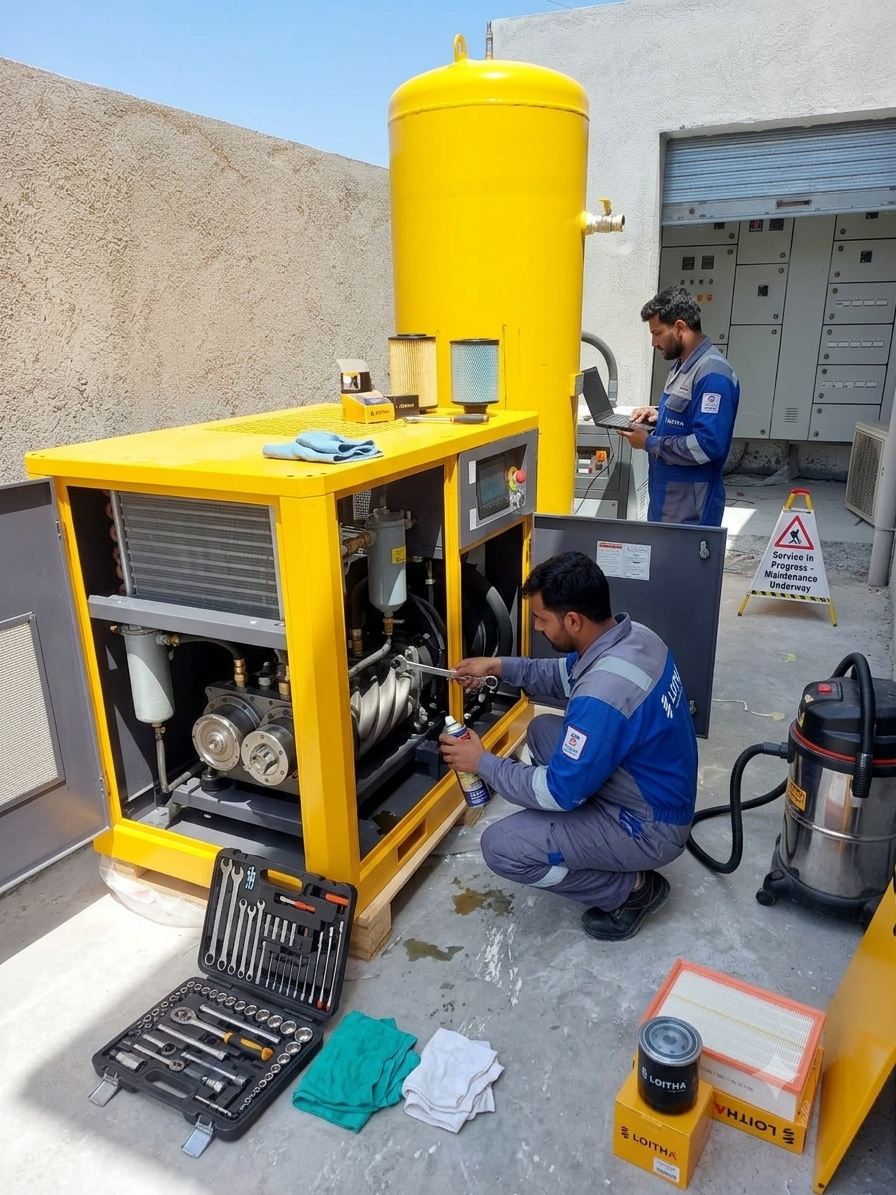
What Should Technicians Check During Screw Compressor Service
Professional service should involve more than changing oil and filters. A useful inspection considers the compressor as part of the complete compressed air system.
Technicians may inspect:
- Inlet air filter
- Lubricant condition and level
- Oil filter
- Air oil separator
- Cooler cleanliness
- Cooling fan
- Inlet valve
- Minimum pressure valve
- Hoses and connections
- Condensate drains
- Temperature and pressure sensors
- Electrical connections
- Controller alarms and service history
- Drive system
- Air leaks
- Operating pressure and temperature
The exact work required should follow the manufacturer instructions for the specific machine.
1. Filters and Pressure Drop Matter More Than They Look
A dirty filter does not always cause an immediate shutdown. Instead, restriction can gradually increase pressure loss and make the compressed air system less efficient.
The same principle applies to downstream filtration. Excessive pressure drop means the compressor may need to operate at a higher discharge pressure to provide the required pressure at the point of use.
That is why maintenance teams should consider pressure drop, air demand, leakage, filtration, and compressor performance together rather than viewing each component separately.
2. Lubricant Condition Cannot Be Judged by Hours Alone
Lubricant performs several important functions in an oil injected screw compressor, including lubrication, cooling, and sealing.
Its useful life depends on the correct lubricant specification, temperature, operating environment, load, contamination, and manufacturer recommendations.
Never assume that any compressor oil with similar viscosity is suitable. Use lubricant that meets the compressor manufacturer’s required specification and follow the prescribed replacement procedure.
3. Cooling System Inspection Can Prevent Overheating
Dirty coolers and poor ventilation can increase operating temperature.
Keep the compressor room ventilated and prevent hot discharge air from recirculating into the intake. Cooling surfaces should also be inspected and cleaned using an appropriate method for the equipment.
If discharge temperature begins increasing beyond its normal operating trend, investigate the cause instead of repeatedly resetting temperature alarms.
How Preventive Screw Air Compressor Maintenance Protects Production
Preventive maintenance is valuable because a compressor problem can affect far more than the compressor itself. When compressed air supports production equipment, unexpected shutdown can interrupt several processes simultaneously.
A planned service strategy allows maintenance teams to identify deterioration before it develops into an emergency.
1. Build Maintenance Around Condition and Data
Keep a service record for each Screw Air Compressor and record:
- Running hours
- Service dates
- Parts replaced
- Lubricant used
- Operating pressure
- Discharge temperature
- Controller warnings
- Abnormal vibration or noise
- Recurring leaks
- Previous repairs
This information creates a useful performance history.
For example, if operating temperature gradually increases between inspections, maintenance teams can investigate ventilation, cooler contamination, lubricant condition, or other causes before an overheating shutdown occurs.
2. Preventive Maintenance Can Support Energy Efficiency
Maintenance and energy efficiency are closely connected.
Dirty filtration, unnecessary pressure drop, compressed air leaks, and operating at more pressure than the process requires can increase system energy demand.
Therefore, servicing should include more than replacement parts. Reviewing the complete compressed air system can reveal losses that normal compressor maintenance alone may not identify.
3. When Should You Call a Screw Compressor Service Engineer
Call an experienced technician when the compressor repeatedly trips, overheats, develops abnormal vibration, produces unusual sounds, shows unexplained oil carryover, cannot maintain expected pressure, or displays recurring controller faults.
Operators can perform routine visual checks, but internal service should follow proper isolation and safety procedures.
Screw Air Compressor Service FAQs for Industries in India
Service frequency depends on running hours, compressor model, lubricant, load and operating environment. Industries in India should follow manufacturer recommendations while also considering local heat, humidity and dust conditions. High ambient temperatures can increase cooling demands and thermal stress. Plants operating in hotter regions of India should pay particular attention to ventilation, cooler cleanliness, lubricant condition and normal discharge temperature trends. Use manufacturer specified running hours and calendar limits together with actual machine condition. Controller alerts, temperature, pressure, lubricant condition and the operating environment should also guide maintenance decisions. Yes. Dust can contaminate intake filters and cooling surfaces more quickly. A Screw Air Compressor operating in a dusty environment may therefore require inspection or cleaning sooner than a machine operating in cleaner conditions. Watch for high temperature, unusual noise, excessive vibration, oil leakage, recurring alarms, reduced air delivery, slow pressure build up and abnormal operating behaviour. Higher energy use can result from air leaks, pressure losses, dirty filtration, inappropriate pressure settings or changes in plant air demand. The complete compressed air system should be checked before assuming the compressor itself has failed. No FAQ found.
Important components include the air filter, oil filter, air oil separator, lubricant, coolers, hoses, valves, drains, sensors, drive components and electrical connections. Not always. A compressor operating continuously can reach its specified service hours long before one year. Indian factories should monitor actual running hours, operating conditions and manufacturer service requirements. No. Use lubricant that meets the compressor manufacturer’s required specification. Using an unsuitable lubricant can affect lubrication, cooling, sealing and overall compressor performance. Yes. Compressed air leaks create unnecessary demand. This can make the compressor load more frequently or operate for longer periods, increasing energy consumption and running hours. Maintain records of running hours, service dates, lubricant changes, filters and parts replaced, temperature, pressure, alarms, leaks and previous repairs. These records help identify performance trends. Arrange professional inspection when you notice recurring alarms, overheating, abnormal vibration, unusual noise, excessive oil carryover, leakage or difficulty maintaining expected system pressure. No FAQ found.
Plan Screw Air Compressor Service Before Downtime Plans It for You
A reliable Screw Air Compressor maintenance strategy is not built around one universal service interval. It combines manufacturer recommendations with running hours, actual operating conditions, controller information, component condition, and performance trends.
At Loitha Air Compressor, we help industrial users maintain dependable compressed air systems through planned maintenance, technical inspection, genuine spare support, installation assistance, and compressor service.
If your compressor is approaching its service interval or showing unusual pressure, temperature, noise, vibration, or performance changes, contact Loitha Air Compressor to schedule a professional inspection and plan maintenance before an unexpected shutdown affects production.