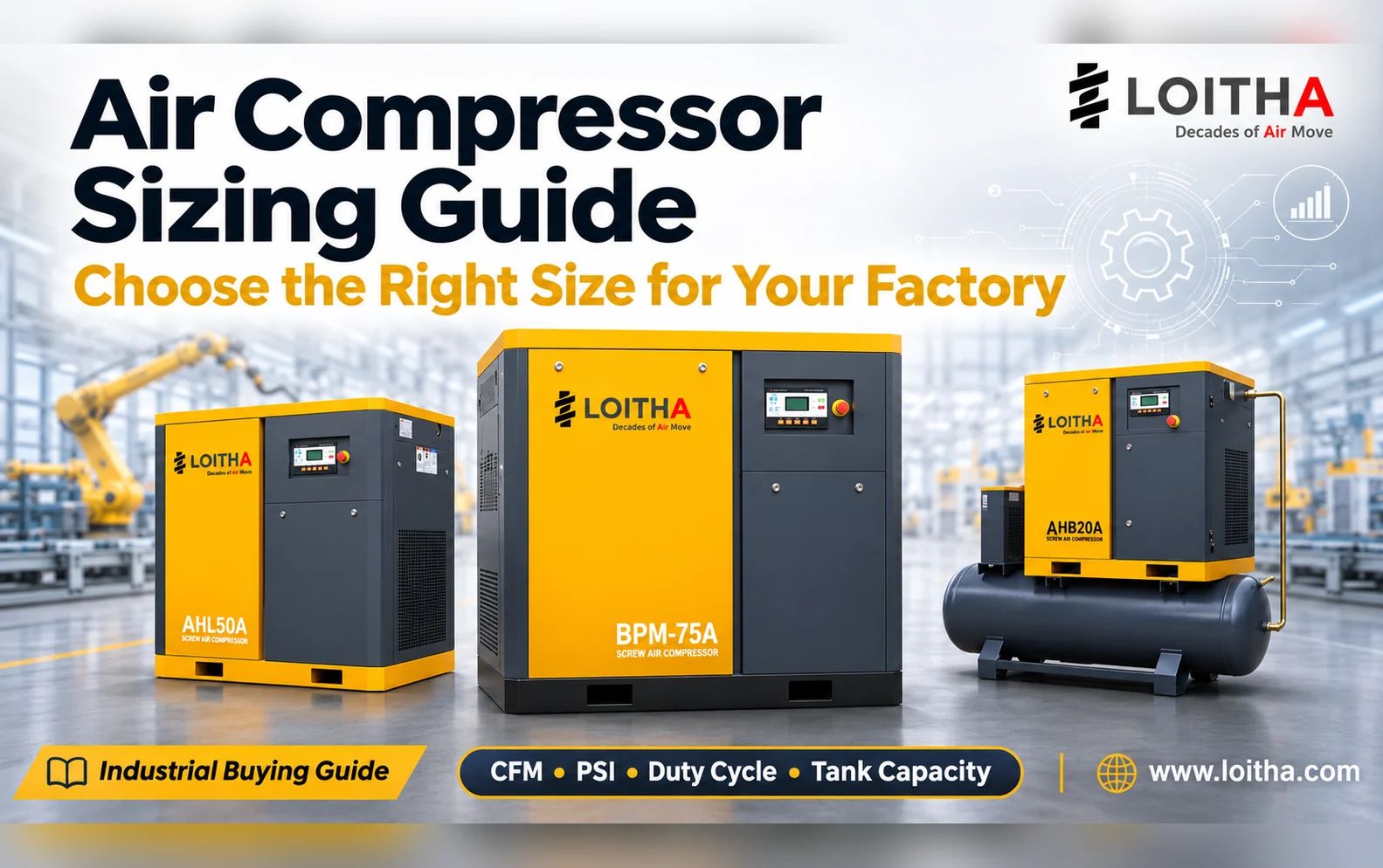
Air Compressor Sizing Guide: How to Choose the Right Size
Choosing the right air compressor starts with understanding your compressed-air requirements, not simply picking a machine with more horsepower or a larger tank. The correct size depends on airflow (CFM), operating pressure (PSI or bar), duty cycle, simultaneous equipment usage, and air quality. This air compressor sizing guide explains how to calculate your requirements and select a suitable compressor for reliable, energy-efficient industrial operation.
Whether you operate a manufacturing plant, automotive workshop, CNC machining facility, textile unit, or packaging business, proper compressor sizing helps maintain consistent air pressure, support productivity, and control operating expenses.
How to Calculate the Right Air Compressor Size
To calculate the right air compressor size, determine the air consumption of every connected machine, identify which machines operate simultaneously and calculate their combined CFM requirement. Then establish the minimum operating pressure needed at the equipment, consider system pressure losses and select a compressor that delivers sufficient Free Air Delivery (FAD) at the required pressure.
Step 1: Identify Your Equipment’s Air Consumption
Start by listing all equipment that requires compressed air.
Check each machine’s technical specifications for:
Air consumption in CFM or L/min
Required operating pressure in PSI or bar
Duration and frequency of operation
Number of machines operating simultaneously
Peak and average compressed air demand
For example, spray guns, impact wrenches, pneumatic cylinders and CNC equipment may have different airflow and pressure requirements.
Always use actual equipment specifications rather than estimating requirements from motor horsepower alone.

Step 2: Calculate the Total Airflow Requirement
Your compressor must support the combined air demand of equipment operating at the same time.
Example: Air Compressor CFM Calculation
| Equipment | Air Consumption |
|---|---|
| Machine A | 15 CFM |
| Machine B | 20 CFM |
| Machine C | 25 CFM |
| Total Air Requirement | 60 CFM |
Formula:
Total CFM = Sum of the airflow requirements of simultaneously operating equipment.
15 + 20 + 25 = 60 CFM
If all three machines operate simultaneously, their combined requirement is 60 CFM.
However, the final compressor selection should also account for actual operating patterns, air leakage, pressure losses and reasonably anticipated future demand.
Avoid unnecessary oversizing. A compressed air audit can help determine actual requirements.
Step 3: Determine Your Required Operating Pressure
Pressure is generally measured in PSI or bar.
Your compressor must provide sufficient pressure at the equipment inlet during normal operation.
Consider:
Minimum equipment operating pressure
Pipeline and fitting pressure losses
Pressure drop across air filters and dryers
Required pressure at each point of use
Compressor pressure control settings
Selecting a compressor that operates at unnecessarily high pressure can increase energy consumption.
Step 4: Evaluate the Duty Cycle
Duty cycle describes how frequently and for how long the compressor operates.
Intermittent operation: Equipment requires compressed air occasionally, with breaks between operations. Suitable reciprocating compressors and receiver tanks may support this type of demand.
Regular operation: Equipment operates frequently throughout the working day, requiring reliable airflow and pressure.
Continuous operation: Machinery requires compressed air for extended periods. Rotary screw compressors are commonly selected for these industrial applications.
The selected compressor must be rated for the intended operating conditions.
Step 5: Consider Future Expansion
If you plan to add production lines or pneumatic equipment, consider how these changes may affect your compressed air demand.
Select reasonable expansion capacity without installing a substantially oversized compressor.
The objective is to match actual demand efficiently while allowing for planned growth.
Understanding CFM, PSI and HP in Air Compressor Sizing
Three important specifications in compressor selection are airflow, pressure and motor power.
What Is CFM in an Air Compressor?
CFM stands for Cubic Feet per Minute. It indicates the volume of air delivered over a period of time.
Airflow can also be expressed in L/min, m³/min or m³/hr.
For industrial compressors, Free Air Delivery (FAD) is particularly important because it represents actual delivered air volume under stated reference conditions.
Compare the compressor’s rated FAD at the required operating pressure rather than relying only on theoretical displacement.
What Is PSI in an Air Compressor?
PSI stands for Pounds per Square Inch and measures air pressure.
Pressure determines whether compressed air can operate the connected equipment effectively.
CFM and PSI work together. A compressor must deliver the necessary volume of air at the required pressure.
Does Higher Horsepower Mean More Airflow?
Not necessarily.
Horsepower (HP) and kilowatts (kW) indicate motor power, but two compressors with similar motor ratings may deliver different airflow depending on their design, compression technology and operating pressure.
Compare actual FAD, pressure, specific power consumption and motor efficiency before making a decision.
Air Compressor CFM and Pressure Requirements by Application
Different tools and industrial machines require different levels of compressed air.
The following values are indicative reference ranges from the sizing guide.
| Application | Airflow (CFM) | Pressure (PSI) |
|---|---|---|
| Airbrush | 0.5–1.5 | 20–30 |
| Spray gun | 4–8 | 30–50 |
| Nail gun | 1–2 | 70–90 |
| Sandblasting | 6–25 | 70–90 |
| Impact wrench | 3–5 | 90–100 |
| Air ratchet | 3–5 | 90–100 |
| Grinder | 5–8 | 90–120 |
| Automotive assembly | 8–15 | 90–120 |
| HVAC systems | 6–12 | 80–100 |
| Food and beverage packaging | 4–10 | 70–90 |
Important: These values are illustrative, not universal sizing recommendations. Actual air consumption and operating pressure vary by equipment design, operating conditions and manufacturer specifications. Always verify requirements using the equipment datasheet.
Types of Air Compressors and Their Applications
Choosing the correct compressor technology is essential for efficient operation.
1. Reciprocating Air Compressor
A reciprocating compressor uses a piston moving inside a cylinder to compress air.
It is commonly used for intermittent compressed air requirements.
Typical applications include:
Automotive workshops
Tyre inflation
Small manufacturing facilities
Maintenance operations
General pneumatic tools
2. Rotary Screw Air Compressor
A rotary screw compressor uses intermeshing helical rotors to compress air.
This technology is widely used for industrial applications requiring continuous and dependable compressed air delivery.
Common applications include:
Manufacturing facilities
CNC machining
Automotive production
Textile industries
Packaging machinery
Laser cutting
Industrial automation
Explore Loitha’s Rotary Screw Air Compressors for industrial compressed air applications.
3. Scroll Air Compressor
Scroll compressors use spiral-shaped elements to compress air and are known for relatively quiet operation and smooth air delivery.
They are commonly considered for specialized applications such as medical equipment, dental facilities, laboratories and electronics manufacturing.
Oil-free configurations are also available.
Fixed-Speed vs Variable-Speed Air Compressors
Compressor motor control technology can influence energy efficiency and operating performance.
Fixed-Speed Air Compressor
Fixed-speed compressors operate at a constant motor speed, with air output managed through loading, unloading or other controls.
They can be appropriate for applications with stable and predictable compressed air demand.
Variable-Speed Drive Air Compressor
A Variable Speed Drive (VSD) compressor adjusts motor speed according to changing air demand within its operating range.
Potential advantages include:
Improved efficiency under variable-demand conditions
Reduced unnecessary unloaded operation
More stable system pressure
Greater operating flexibility
Better matching of air delivery to demand
Actual energy savings depend on the compressor’s size, demand profile and operating conditions.
Learn more about Loitha’s VFD Air Compressors and Variable Speed Screw Air Compressors.
Air Compressor Tank Size vs Airflow Capacity
A common compressor sizing mistake is confusing air receiver tank capacity with compressor airflow.
Airflow capacity determines how much compressed air a compressor can deliver over time.
Tank capacity determines how much compressed air can be stored within the receiver’s operating pressure range.
A larger air receiver tank can help:
Support temporary peak air demand
Reduce pressure fluctuations
Reduce frequent loading and unloading
Provide temporary compressed air storage
Support stable system operation
However, a larger tank does not increase compressor FAD or compensate for insufficient airflow during continuous operation.
Explore Loitha’s Tank Mounted Air Compressors for integrated industrial compressor configurations.
Why Air Dryers and Filters Matter
Correct compressor sizing is only one part of designing an effective compressed air system.
Compressed air can contain moisture, particles, oil aerosols and other contaminants.
Depending on the application, treatment equipment may be required to protect machinery and maintain air quality.
1. Air Dryers
Air dryers reduce moisture and help prevent condensation.
Common types include refrigerated, desiccant, heatless regenerative and heated desiccant air dryers.
Dryer selection depends on required pressure dew point and operating conditions.
2. Compressed Air Filters
Filters remove contaminants from compressed air.
Available filtration technologies include particulate filters, general-purpose filters, fine coalescing filters and activated carbon filters.
3. Moisture Separators and Pipelines
Moisture separators remove bulk liquid water, while properly designed compressed air pipelines help reduce pressure loss.
When designing pipelines, consider diameter, material, fittings, bends, condensate drainage and future expansion.
Frequently Asked Questions About Air Compressor Sizing
Calculate the combined CFM requirement of equipment operating simultaneously. Identify the necessary pressure in PSI or bar, evaluate the duty cycle and select a compressor with sufficient rated Free Air Delivery at that pressure. Your required CFM depends on the air consumption of the connected equipment. Add the requirements of machines operating simultaneously, then consider leakage, operating patterns and future requirements before selecting compressor capacity. CFM measures airflow volume per minute, while PSI measures pressure. Both must match the equipment’s requirements for reliable pneumatic operation. Rotary screw compressors are commonly suitable for continuous industrial operation. Reciprocating compressors can serve intermittent applications, while scroll compressors may suit specialized, relatively quiet or oil-free requirements. No. A larger air receiver tank increases compressed air storage, not compressor airflow capacity. It can support short-duration peak demand but cannot replace sufficient compressor FAD during continuous operation. No FAQ found.
Not always. Higher horsepower does not automatically indicate better compressor performance. Compare rated airflow, operating pressure, energy efficiency and the application’s actual requirements. An air dryer is recommended when moisture could damage machinery, affect production or reduce product quality. Choose the dryer according to the required air quality and pressure dew point. Fixed-speed compressors generally operate at constant motor speed, whereas VSD compressors adjust motor speed as compressed air demand changes. VSD technology can improve efficiency when demand varies. Service intervals depend on compressor design, operating hours and environmental conditions. Follow the manufacturer’s schedule and inspect consumables, filters, lubricants and other critical components regularly. Check required CFM, working pressure, motor power, compressor technology, duty cycle, tank capacity, air treatment, energy efficiency, electrical supply, installation conditions and maintenance support. No FAQ found.

Important Factors to Check Before Buying an Industrial Air Compressor
Apart from airflow and pressure, businesses should evaluate the complete compressed air system before purchasing.
1. Energy Efficiency
Compare specific power consumption, motor efficiency, actual air demand, and compressor control technology.
Reducing air leakage and avoiding unnecessary pressure can also improve system performance.
2. Installation Space and Ventilation
Check floor space, compressor dimensions, ambient temperature, cooling airflow and maintenance access.
3. Electrical Supply
Verify the available voltage, frequency, phase, motor starting method and electrical protection.
4. Noise Level
Check manufacturer-rated noise levels in dB(A), especially for indoor workshops and production facilities.
5. Maintenance and Service
Review spare-part availability, service requirements and manufacturer-recommended maintenance intervals.
Regular maintenance may include inspecting air filters, oil filters, separators, lubricants, cooling systems and condensate drains.
What Happens If You Choose the Wrong Air Compressor Size?
Incorrect compressor sizing can affect equipment reliability, production performance and operating costs.
Problems with an Undersized Compressor
Frequent pressure drops
Inconsistent machine performance
Insufficient air during peak demand
Longer production cycles
Production interruptions
Excessive compressor running
Problems with an Oversized Compressor
Higher initial investment
Unnecessary energy consumption
Increased unloaded running
Frequent loading and unloading
Possible short cycling
Reduced operating efficiency
Selecting equipment based on verified compressed air requirements helps avoid these problems.
Conclusion: Select the Right Air Compressor for Your Business
The best air compressor is not necessarily the machine with the highest horsepower or largest storage tank. It is the compressor that delivers the required airflow and pressure efficiently for your application.
Start by calculating actual compressed air demand, identifying required operating pressure and understanding the duty cycle. Then compare compressor technologies, air treatment requirements, energy consumption and maintenance needs.
Proper compressor sizing helps maintain consistent pressure, support production efficiency and reduce unnecessary operating costs.
Need help selecting an industrial air compressor?
Explore Loitha’s Industrial Air Compressor Range to compare compressor technologies and specifications for different industrial requirements.
Visit www.loitha.com to learn more about suitable compressed air solutions for your business.
Contact Loitha to discuss your industrial compressed-air requirements.
Website: https://www.loitha.com/
Call Us: +91 9601415434
Email Us: info@loitha.com