Oil Free Compressor Buying Guide for Clean Air in India 2026
Buying an industrial compressor is not simply about choosing horsepower or comparing quotations. One overlooked factor can affect product quality, maintenance budgets, and daily production: how oil is handled during compression.
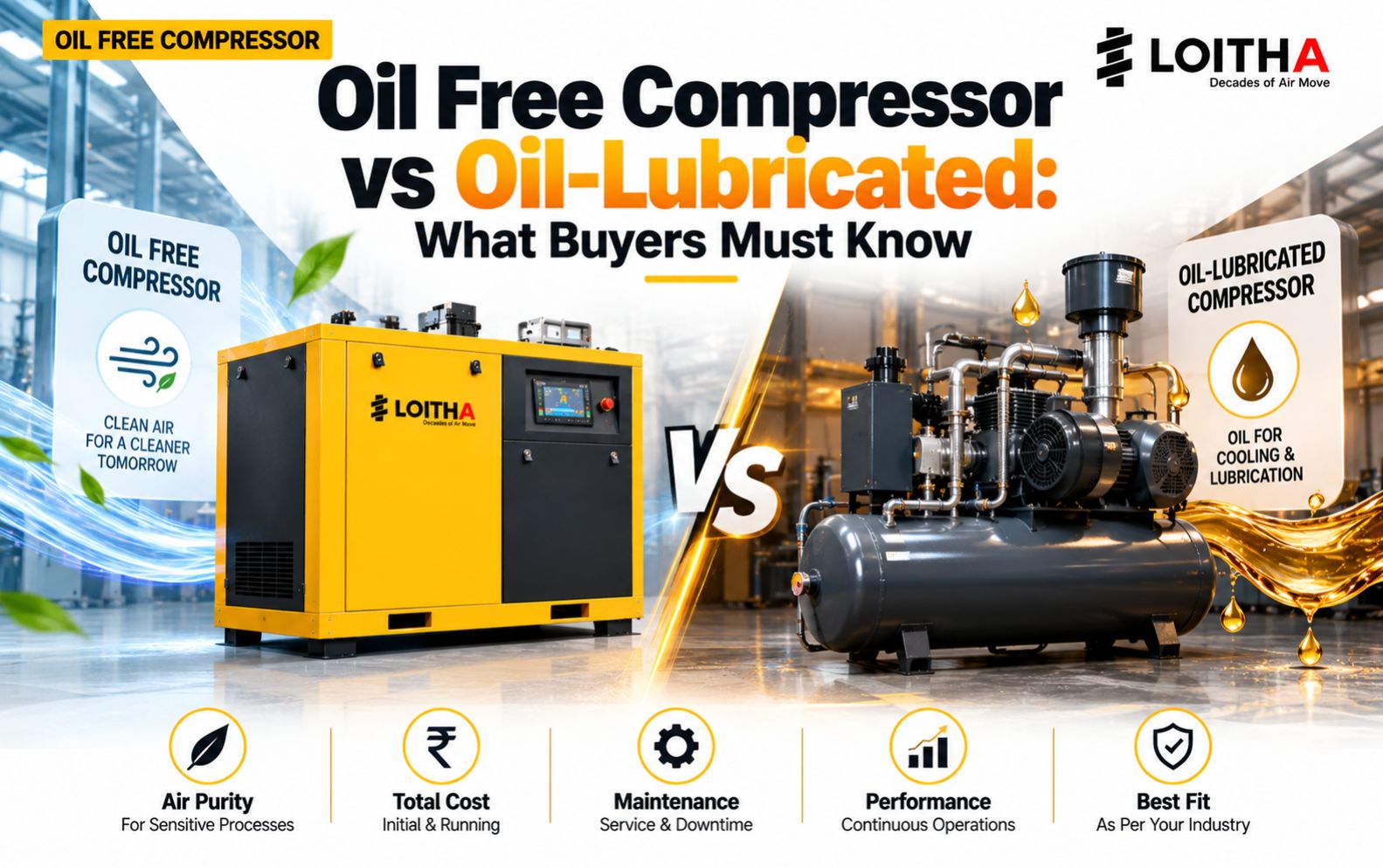
An Oil Free Compressor and an oil-lubricated compressor can both supply compressed air, but they operate differently and introduce different contamination risks.
For manufacturers in India, the right choice depends on the production process, required air purity, energy demand, and total ownership cost.
This guide explains the differences, identifies common purchasing mistakes, and provides practical questions to ask before investing.
Oil Free Compressor vs Oil-Lubricated: Understanding the Real Differences
How Does Each Compressor Technology Work?
An Oil Free Compressor compresses air without introducing lubricating oil into the compression chamber. Some designs still use lubricants in separate mechanical components, but those lubricants are isolated from the compression process.
An oil-lubricated screw compressor injects oil into the compression chamber to assist with cooling, sealing, and lubrication. The compressed air subsequently passes through separation equipment to remove most of the oil.
Both technologies are suitable for industrial use when correctly selected, installed, and maintained.
Air Purity: Why the Difference Matters
Air contamination is especially important when compressed air contacts products, packaging, or sensitive manufacturing equipment.
An oil-free design eliminates the intentional introduction of lubricant into the compression chamber, reducing one potential source of contamination.
Oil-lubricated compressors can also produce highly purified compressed air when suitable filtration and treatment systems are installed.
However, neither compressor type automatically guarantees contaminant-free air at the point of use.
The correct decision starts with the required air-quality specification, not the compressor label.
Oil Free Compressor vs Oil-Lubricated: Quick Comparison
| Buying Factor | Oil Free Compressor | Oil-Lubricated Compressor |
|---|---|---|
| Compression Chamber | No injected lubricating oil | Oil participates in compression |
| Initial Investment | Often higher | Often lower |
| Oil Contamination Risk | Avoids oil injection into the air path | Requires oil separation and treatment |
| Maintenance | Design-dependent servicing | Oil, separator, and filter servicing |
| Air Treatment | Still required as specified | Required as specified |
| Best Fit | Applications prioritizing low oil-contamination risk | Many general industrial applications |
Actual performance depends on equipment design, air treatment, and operating conditions.
Three Purchasing Mistakes Worth Avoiding
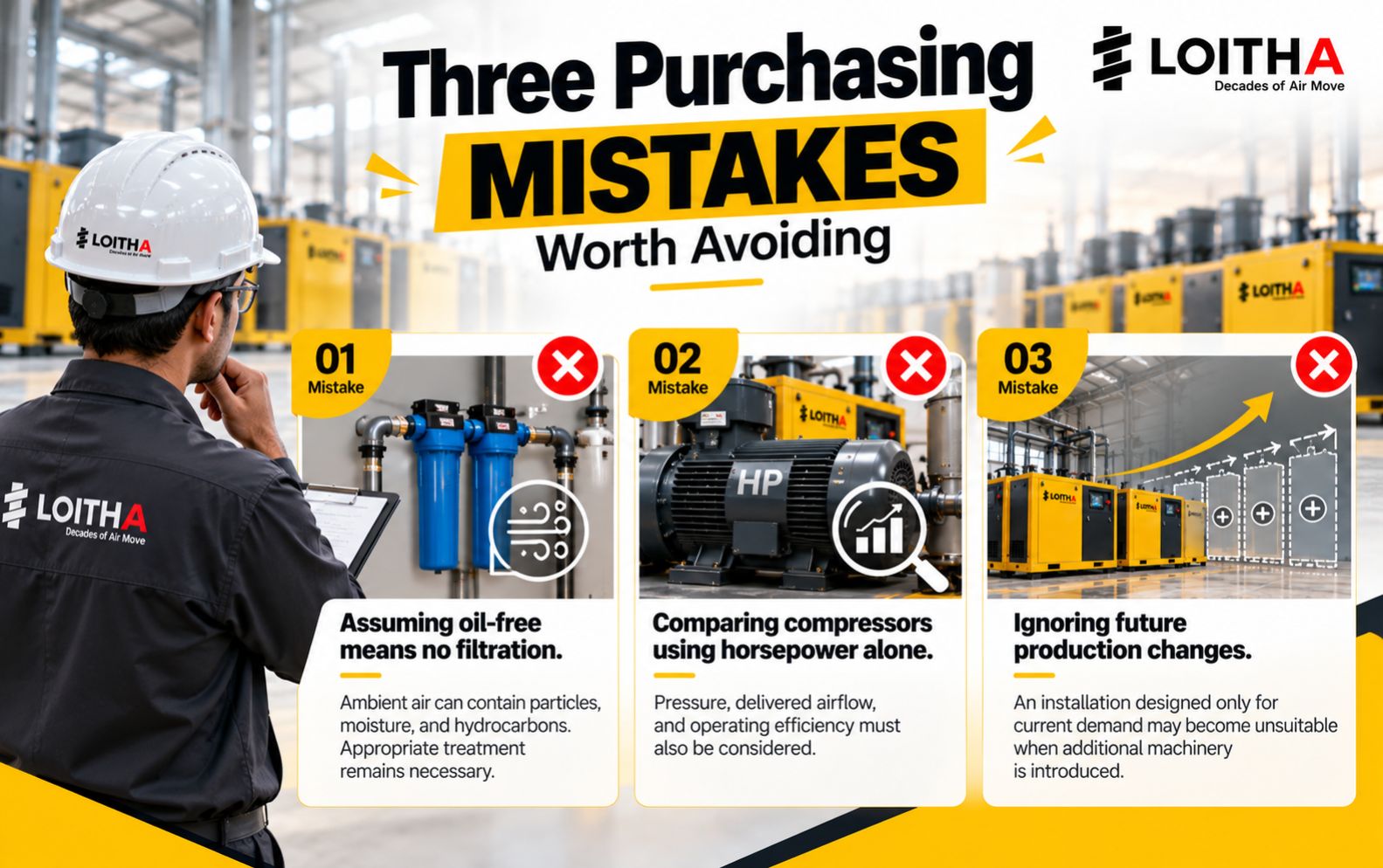
Mistake 1: Assuming oil-free means no filtration.
Ambient air can contain particles, moisture, and hydrocarbons. Appropriate treatment remains necessary.
Mistake 2: Comparing compressors using horsepower alone.
Pressure, delivered airflow, and operating efficiency must also be considered.
Mistake 3: Ignoring future production changes.
An installation designed only for current demand may become unsuitable when additional machinery is introduced.
ISO 8573-1: What Indian Buyers Should Understand
ISO 8573-1 classifies compressed-air purity for particles, water, and oil.
Class 0 does not mean absolutely zero contamination. It represents a specified purity level stricter than Class 1 for the relevant contaminant.
Buyers should request the applicable class, documented limits, test conditions, and measurement location.
For critical processes, air-quality verification at the point of use is more meaningful than relying on a general marketing claim.
Where Oil-Free Technology Makes Practical Sense
Industries frequently evaluating oil-free compressed-air solutions include:
Food and beverage: Packaging, handling, and product-contact processes.
Pharmaceuticals: Sensitive production and equipment applications.
Electronics: Operations where contamination can affect components.
Chemical processing: Processes with defined purity requirements.
Textiles: Selected manufacturing operations requiring controlled air quality.
Not every application within these industries requires the same compressor technology.
The decision should follow a process-specific contamination risk assessment.
How Indian Industrial Buyers Can Choose the Right Compressor
1. Compare Ownership Costs, Not Just Purchase Prices
An oil-lubricated compressor may offer a lower initial purchase price. An oil-free system may reduce reliance on oil separation within the compression process.
However, neither option is automatically cheaper throughout its operating life.
Evaluate the complete compressed-air installation, including:
Equipment purchase and installation.
Electricity consumption under actual operating conditions.
Dryers, filters, and air-treatment equipment.
Routine servicing and replacement components.
Downtime exposure and production requirements.
Air-quality testing and monitoring.
Total cost of ownership provides a more useful comparison than equipment price alone.
2. Match Pressure and Airflow to Actual Demand
Oversized compressors can waste energy, while undersized systems may struggle to support production.
Before requesting a quotation, document the required pressure, free air delivery, simultaneous equipment usage, and operating schedule.
Also consider future expansion, distribution pressure losses, and periods of fluctuating demand.
A properly sized system can support more efficient operation regardless of compressor technology.
3. Ask About Energy Performance
Electricity is a major consideration for facilities operating compressed-air equipment over extended periods.
Compare compressor performance at the same delivered pressure and airflow, rather than relying only on motor power.
Where air demand varies significantly, variable-speed technology may help reduce unnecessary energy consumption.
The actual benefit depends on the demand profile, controls, and overall system design.
4. Evaluate Maintenance and Service Availability
Oil-free does not mean maintenance-free.
Both technologies require inspections, suitable operating conditions, and servicing according to manufacturer recommendations.
Ask suppliers about service intervals, consumables, spare parts, technician availability, and expected maintenance procedures.
For facilities operating multiple shifts, reliable support can be particularly important.
A Practical Checklist before Buying Oil Free Compressor India
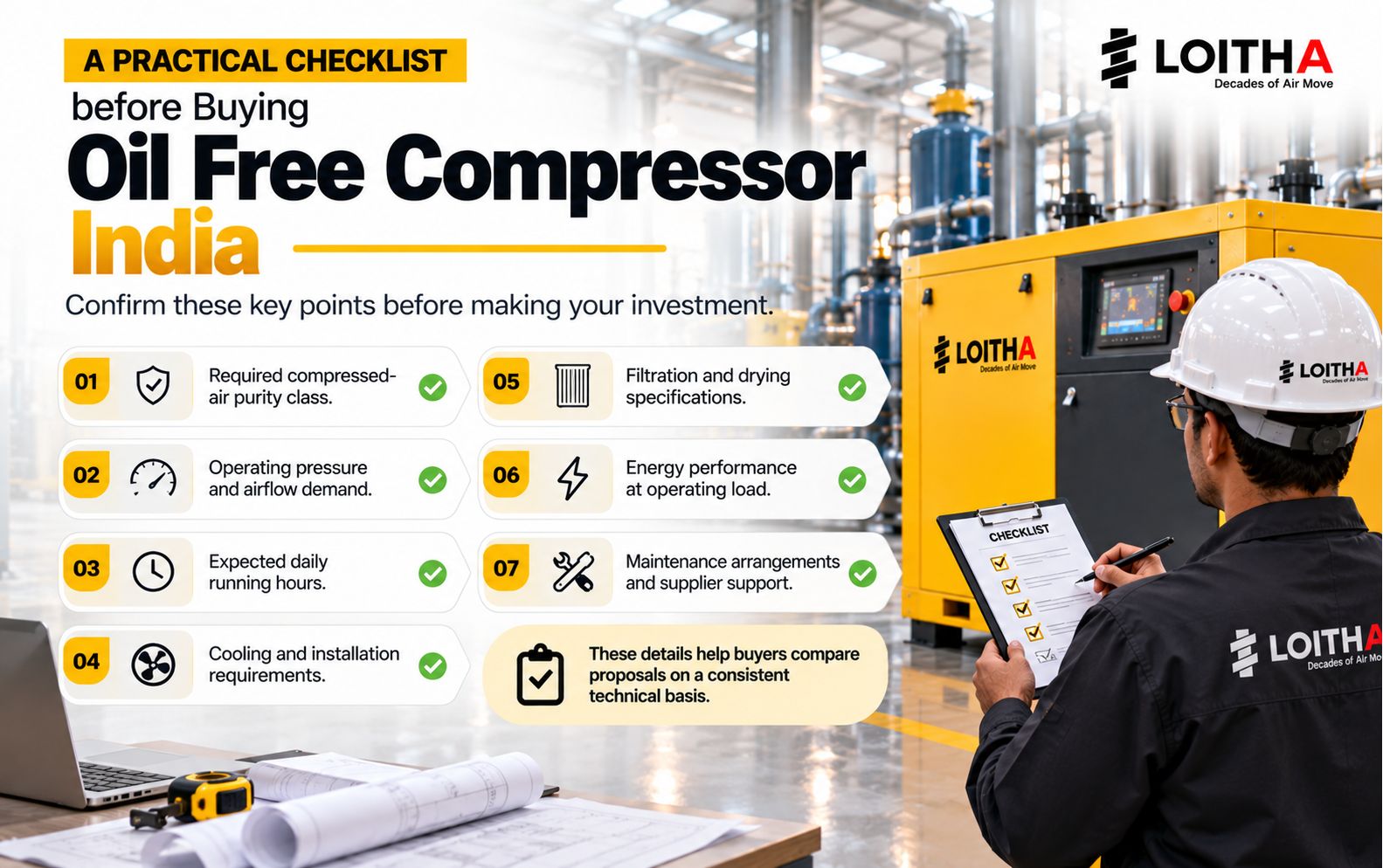
Before finalizing an Oil Free Compressor, confirm:
Required compressed-air purity class.
Operating pressure and airflow demand.
Expected daily running hours.
Cooling and installation requirements.
Filtration and drying specifications.
Energy performance at operating load.
Maintenance arrangements and supplier support.
These details help buyers compare proposals on a consistent technical basis.
Frequently Asked Questions About Oil Free Compressors in India
Yes, models designed for continuous-duty operation can support extended production schedules. Buyers should confirm the manufacturer’s duty rating and operating conditions. A rotary screw air compressor uses rotating screw elements to compress air. It is commonly used in industrial applications that require a regular or continuous compressed-air supply. It can be suitable when the complete air system meets the process’s documented purity requirements. Appropriate testing and validation remain important. Request technical specifications, air-quality documentation, service arrangements, and model suitability. Buyers should also confirm delivery and support availability. Yes. Suitable separation, filtration, and purification systems can achieve defined air-quality classes when properly engineered and maintained. Higher ambient temperatures can influence cooling requirements and operating performance. Check the model’s specified temperature range. No FAQ found.
No. Savings depend on the facility’s demand pattern. Constant-load operations may favor different equipment configurations. Compare delivered airflow, pressure, energy use, air-treatment requirements, warranties, servicing, and overall ownership costs. Some manufacturers offer nationwide supply. Confirm whether the selected supplier across main cities in India provides local installation and service arrangements. Compressor discharge quality describes air leaving the equipment. Point-of-use quality also reflects downstream filtration, piping, storage, and environmental conditions. Yes, particularly for sensitive processes. Confirm the tested contaminants, measurement methods, operating conditions, and relevant purity classes. Check product documentation, technical assistance, service coverage, and application knowledge. A manufacturer in Gujarat serving major Indian cities should clarify its support arrangements. No FAQ found.
Rotary Screw Compressor Manufacturer in Ahmedabad Gujarat
Loitha manufactures industrial compressed air equipment for customers seeking a Rotary Screw Compressor Manufacturer in Ahmedabad, Gujarat, India.
We also serve businesses in Rajkot and industrial markets across India and internationally.
Industrial buyers can contact Loitha to discuss compressor configurations, technical requirements, delivery arrangements, and available support.
Conclusion: Choose Clean Air With Confidence in India
The right compressor is not necessarily the most expensive or the one with the longest feature list.
It is the system that matches your air-quality requirements, production demand, operating costs, and service expectations.
An Oil Free Compressor deserves consideration where avoiding oil injection into the compression process is particularly valuable.
For industrial buyers comparing solutions, Loitha offers oil-free screw air compressor models for different pressure and airflow requirements.
Explore the Loitha Oil Free Screw Air Compressor range and discuss your application’s specifications before making a purchasing decision.
Call Us: +91 9601415434
Email Us: info@loitha.com